For most of the last century, a flamingo standing in a Florida lagoon was assumed to be an escapee — something that had wandered off from a zoo or a resort pond, not a wild bird belonging there. That assumption has been quietly overturned. Banding and tracking studies now show a real, if small, wild population moving between the Caribbean, the Yucatán, and Florida Bay, exactly the kind of native wildlife the state's plume hunters drove out around 1900.
Everything about a flamingo's feeding posture looks backward until you understand the bill. It's bent sharply downward and built to work upside down: the bird lowers its head into shallow mud, flips the upper half under, and sweeps it side to side while comb-like structures inside strain out small shrimp and algae and let the water and silt pour back out. A flock feeding this way, dozens of pink bodies bent double in a shallow lagoon, is an odd thing to watch.
The color is entirely diet-dependent. A flamingo chick hatches pale gray, and only turns pink as carotenoid pigments from its food build up in new plumage over its first two to three years — a bird on a poor diet stays duller, and captive flamingos fed the wrong food have famously faded toward white until zoos started supplementing their diets.
Like this? Get one bird every morning, by email.
You're in. Your first bird arrives with the next morning email (5:30am ET) — and your life list now syncs.Your account →
How to identify
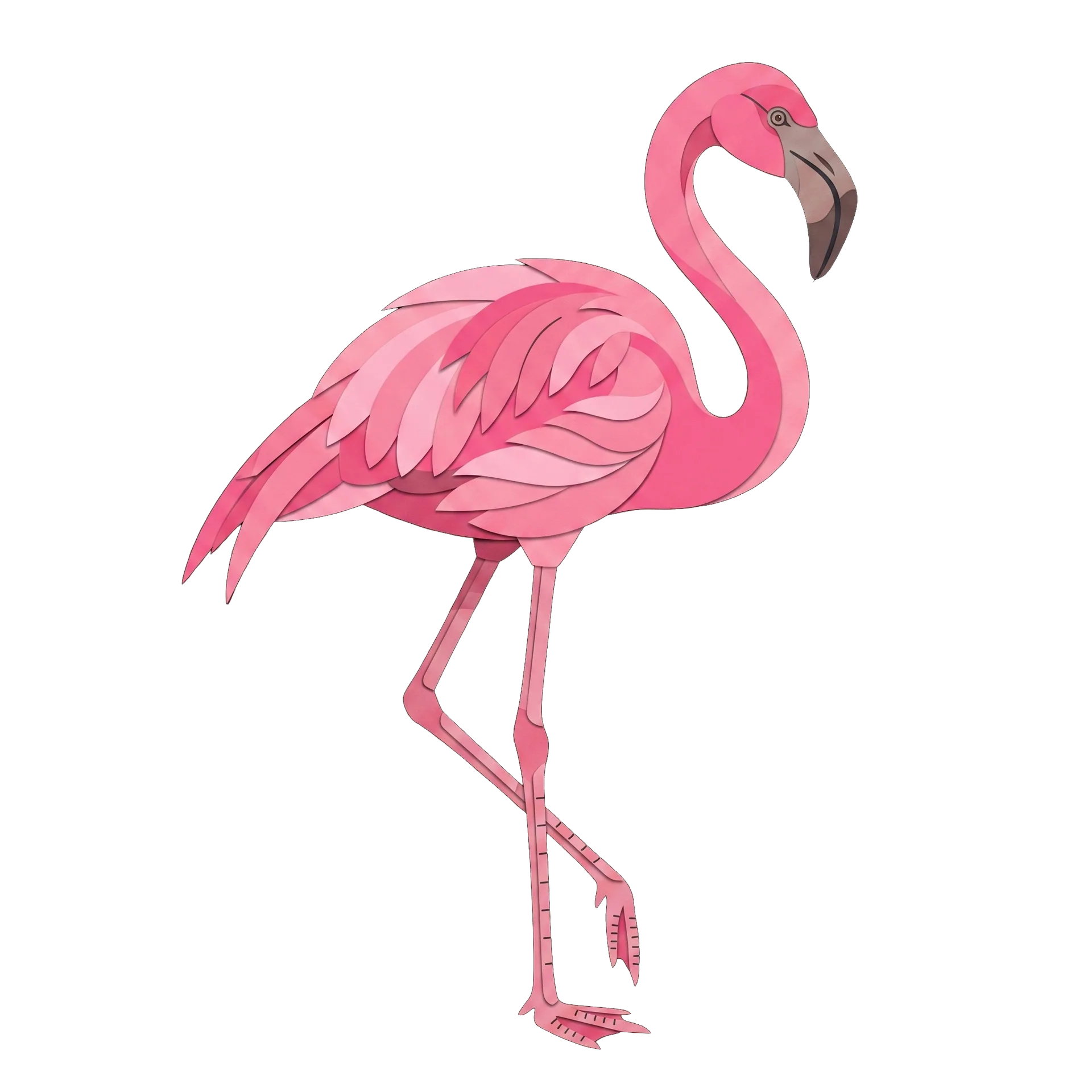
- One of the tallest wading birds in its range, unmistakably rose-pink on stilt-like legs, standing well above the herons and egrets sharing the same wetlands.
- The bill is sharply bent downward and bicolored pink and black — the bird feeds upside down, sweeping it side to side through the mud.
- In flight, shows black flight feathers against the pink body and flies with neck and legs both fully extended.
- Often stands on one leg for long stretches, and forages and roosts in tight flocks rather than alone.
Voice
Low, goose-like honking and grunting, usually heard rising from a feeding flock rather than from a single bird.
Recording: Bobby Wilcox, XC797198, xeno-canto.org (CC-BY-NC-SA 4.0)
Lore
John James Audubon pursued the species for years before he ever saw one alive. Sailing near Indian Key in the Florida Keys on May 7, 1832, he finally spotted a flock coming in low, necks and legs stretched out, and wrote of the moment, 'Ah! reader, could you but know the emotions that then agitated my breast!' He still could not get a specimen, and spent years afterward writing from London to colleagues in Charleston asking them to send him one; he ultimately had to obtain his Florida flamingo material, dried skins and two birds preserved in spirits, from Cuba instead.
The species had its own near-miss in the Caribbean. By the early 1950s, decades of egg collecting, hunting, and low-flying aircraft disturbing the colonies had cut the region's flamingos down to a few thousand birds, most of them on the Bahamian island of Great Inagua. National Audubon Society researcher Robert Porter Allen tracked the colony down, and a newly formed Society for the Protection of the Flamingo hired local brothers Samuel and James Nixon as its first wardens. The colony recovered under their watch, growing into the tens of thousands, and the flamingo is today the national bird of the Bahamas.
At a glance
- Family
- Phoenicopteridae (flamingos)
- Range
- Caribbean, Yucatán, coastal Venezuela and Colombia; recolonizing south Florida
- Habitat
- Shallow saline lagoons, salt pans, and mangrove-lined bays
- Diet
- Small crustaceans, mollusks, and algae, strained from mud with a specialized bent bill
Where it lives
How big is it?
How is it doing?
Field notes
- The pink is borrowed, not built in: flamingo chicks hatch gray, and the color only develops as carotenoid pigments from their shrimp-and-algae diet accumulate in new feathers, reaching full adult color over the first two to three years.
- Plume and egg hunters wiped out Florida's nesting colonies by the early 1900s, and for a century the state's flamingos were dismissed as escapees from zoos — until tracking data and old records confirmed a small wild population has been quietly recolonizing Florida Bay on its own.
- The bent bill is specialized for filter-feeding upside down: flamingos hold their heads below the water surface, upper mandible down, and pump muddy water through comb-like structures that trap prey while flushing out the silt.
Go deeper
The daily email
Get tomorrow's bird in your inbox
One bird at 5:30am ET, every day. Free, no password, one-click unsubscribe — and your life list syncs across devices.
You're in. Your first bird arrives with the next morning email (5:30am ET) — and your life list now syncs.Your account →