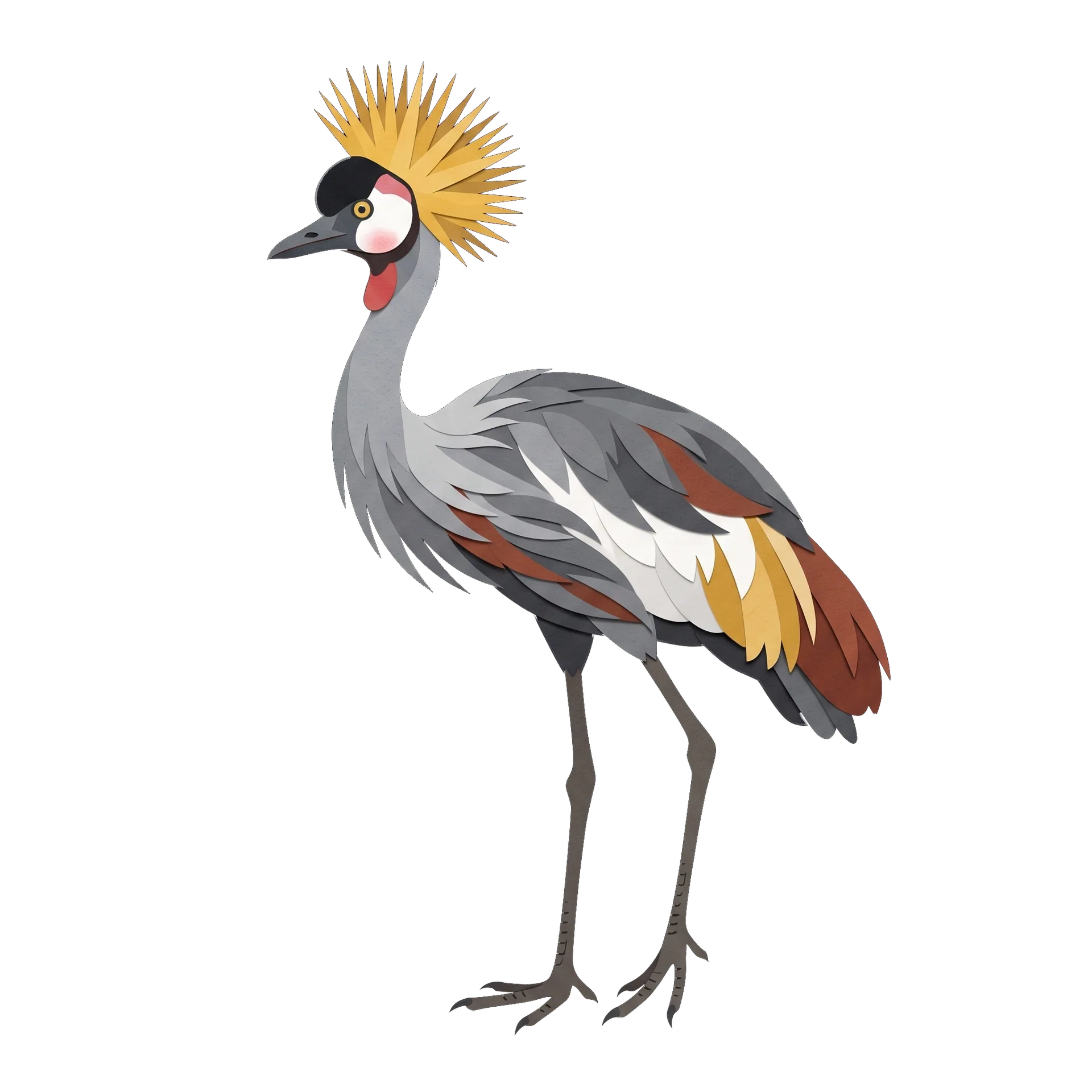
A Grey Crowned Crane's head alone would be enough to make it famous: a spray of stiff, golden bristle feathers standing up like a crown, set off by bare red and white cheek patches and a dangling red throat pouch. It's the image Uganda chose for its national flag, and it's not hard to see why — no other crane, and few birds anywhere, carry anything close to that headdress.
Most cranes are committed ground-dwellers, sleeping standing in open water or marsh where predators have a hard time sneaking up. The Grey Crowned Crane and its close relative the Black Crowned Crane break the pattern: a slightly longer hind toe than other crane species gives them enough grip to roost in trees at night, an option the rest of the crane family simply doesn't have.
The species remains a common sight across East African wetlands and farmland, but the numbers have been sliding for decades. Wetland drainage has shrunk its breeding habitat, and its beauty works against it: illegal capture for the live bird and pet trade removes a steady trickle of birds from the wild, enough that the crane now carries an Endangered listing despite still turning up on postage stamps and coats of arms across the region.
Like this? Get one bird every morning, by email.
You're in. Your first bird arrives with the next morning email (5:30am ET) — and your life list now syncs.Your account →
How to identify
- A slate-gray crane crowned with a spray of stiff, golden bristle feathers, unlike any other crane's head.
- Bare red and white cheek patches and a red throat pouch stand out against the gray body and white wing coverts.
- Unlike most cranes, roosts in trees at night: a habit tied to its longer hind toe, which lets it grip branches.
- Performs an elaborate bowing, leaping courtship dance shared with most crane species, but framed by that unmistakable golden crown.
Voice
A booming, honking call and a distinctive, resonant mewing sound; unusually among cranes it also produces some low sounds without a fully coiled trachea.
Lore
The Grey Crowned Crane's place on Uganda's flag predates the country itself. From 1914, Britain's Uganda Protectorate flew a Blue Ensign defaced with a colonial badge built around the crane, chosen, by most accounts, because administrators wanted a symbol that wouldn't favor any single region: the Kingdom of Buganda already had its own flag, and the crane offered neutral ground. When Uganda designed its own flag ahead of independence, the bird carried straight through. The current design, adopted on 9 October 1962 and generally credited to a cabinet subcommittee chaired by Grace Ibingira, keeps a crested crane in a white disc at its center.
Among the Baganda, Uganda's largest ethnic group, the crane already stood for good fortune, longevity, and wealth before any colonial administrator got involved. What began as a shortcut around regional rivalries has long since become the country's own: more than sixty years after independence, the same bird still tops the national flag and coat of arms.
At a glance
- Family
- Gruidae (cranes)
- Range
- Eastern and southern Africa
- Habitat
- Wetlands, grasslands, and farmland, often near shallow water
- Diet
- Seeds, insects, and small vertebrates, gleaned while walking through grassland
Where it lives
How big is it?
How is it doing?
Field notes
- It's one of only two crane species that regularly roosts in trees (along with its close relative the Black Crowned Crane), made possible by a longer hind toe than other cranes have; every other crane's toe structure keeps it ground-bound at night.
- The species is the national bird of Uganda and appears on the country's flag and coat of arms, one of relatively few birds with that level of national symbolism.
- Populations have fallen sharply in recent decades from wetland drainage and illegal capture for the live bird trade, pushing the IUCN to list it as Endangered despite it still being one of Africa's most recognizable birds.
Go deeper
The daily email
Get tomorrow's bird in your inbox
One bird at 5:30am ET, every day. Free, no password, one-click unsubscribe — and your life list syncs across devices.
You're in. Your first bird arrives with the next morning email (5:30am ET) — and your life list now syncs.Your account →