A Common Tern spots a fish from the air, hangs almost stationary on quick, shallow wingbeats to line up the shot, then folds its wings and drops headfirst in a compact plunge dive — vanishing under the surface for a moment before bursting back up with a small fish held crosswise in its bill. The flight style is the tell that separates terns from gulls at any distance — buoyant and swallow-like, built around lighter bones and longer, narrower wings than a gull of similar size.
A Common Tern defending its nest is a different animal entirely. Colonies can number in the thousands on a single protected island or beach, packed tightly enough that neighboring pairs are only a body-length apart, and any intruder that wanders in (gull, raccoon, or person) gets dive-bombed and struck by birds defending eggs or chicks on the ground.
Fidelity runs deep in a Common Tern's life: pairs often return to the same colony, sometimes the same small patch of sand, to breed year after year, and individuals can live past 25, a long run for a bird this size. Losing a nesting island to development or rising water isn't something a colony easily relocates from — the return instinct that makes the species reliable also makes it slow to adapt when a site disappears.
Like this? Get one bird every morning, by email.
You're in. Your first bird arrives with the next morning email (5:30am ET) — and your life list now syncs.Your account →
How to identify
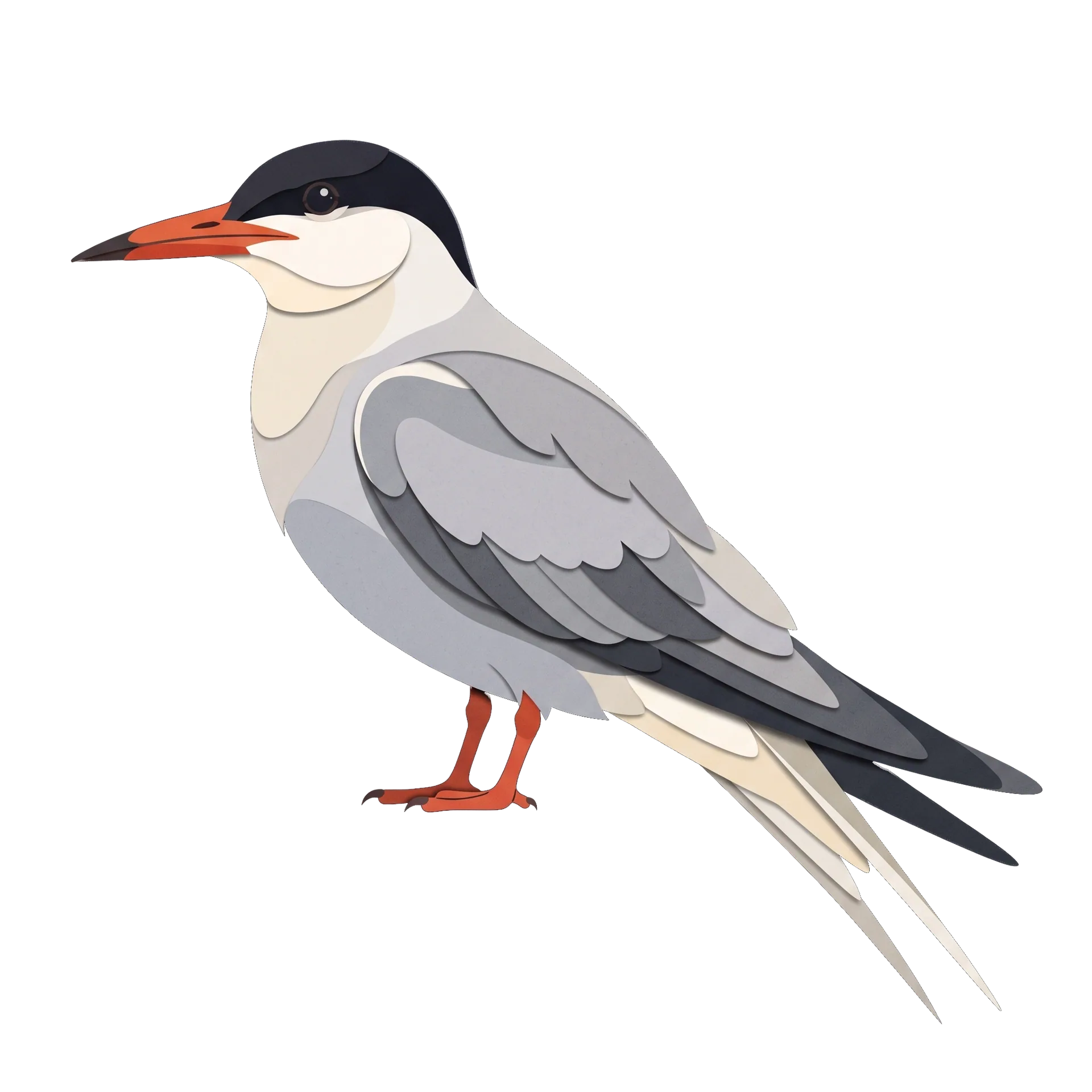
- A slender, pale gray-and-white seabird with a black cap and a deeply forked tail, earning it the old nickname 'sea swallow.'
- Red-orange bill, tipped black in breeding season; legs match the bill color.
- Hovers over the water on quick wingbeats before folding up and plunge-diving headfirst for small fish.
- Compare Forster's Tern (frostier, paler wingtips, and a bill with less black at the tip) and the shorter-legged Arctic Tern, whose bill stays blood-red with little or no black tip.
Voice
A sharp, grating kee-arr, along with shorter alarm calls given while diving at intruders near the colony.
Recording: Jingwen Sun, XC792900, xeno-canto.org (CC-BY 4.0)
At a glance
- Family
- Laridae (gulls & terns)
- Range
- Breeds across North America, Europe, and Asia; winters along tropical and southern coasts
- Habitat
- Coastal beaches and islands, and lake shores, for breeding; open coast and ocean otherwise
- Diet
- Small fish, caught by plunge-diving headfirst from flight
Where it lives
How big is it?
How is it doing?
Field notes
- Terns nest in dense colonies, sometimes thousands of pairs on a single island, and defend them aggressively; birds will dive at and strike intruders, human or otherwise, that stray too close to the nesting ground.
- The buoyant, almost weightless-looking flight that separates terns from gulls at a glance comes from a lighter build and proportionally longer, narrower wings relative to body size.
- Common Terns can live 25 years or more, an unusually long lifespan for a small seabird, and many pairs return to nest at the same colony, sometimes the same patch of ground, year after year.
Go deeper
The daily email
Get tomorrow's bird in your inbox
One bird at 5:30am ET, every day. Free, no password, one-click unsubscribe — and your life list syncs across devices.
You're in. Your first bird arrives with the next morning email (5:30am ET) — and your life list now syncs.Your account →